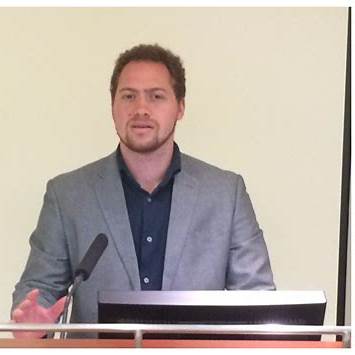
Kieren James-Lubin is the CEO and co-founder of BlockApps and one of the developers behind the Haskell Ethereum client. Son of Joe Lubin, he was present for some of the most pivotal moments in Ethereum's early history, including the "Red Wedding" in Zug. His lean startup background shaped his approach to making Ethereum accessible to enterprise developers.
Background: Mathematical Physics to Blockchain
Before Ethereum, Kieren was pursuing a graduate degree in mathematical physics at UC Berkeley. In January 2014, his father Joe Lubin emailed him from Miami during the Bitcoin conference where Vitalik Buterin first publicly announced Ethereum.
Joe sent Kieren several articles about this new project:
- Introducing Ethereum on YouTube (January 23, 2014)
- Out in the Open: Teenage Hacker Transforms Web Into One Giant Bitcoin Network in Wired Magazine (January 27, 2014)
- Ethereum Launches 'Cryptocurrency 2.0' Network in Coindesk (January 23, 2014)
- Ethereum: A Next-Generation Cryptocurrency and Decentralized Application Platform by Vitalik in Bitcoin Magazine (January 24, 2014)
Kieren decided to join the project on March 22, 2014, and spoke with Vitalik directly on March 24, 2014.
The Red Wedding
In the summer of 2014, Kieren traveled to Zug, Switzerland with his father Joe, witnessing the dramatic leadership shakeup that became known as the "Red Wedding" - when Vitalik made the decision to remove Charles Hoskinson and Amir Chetrit from their leadership positions.
Kieren recalled the atmosphere during this period:
"The summer in Switzerland was pretty dramatic just in terms of the internal politics and like who's up, who's down, like there was also massive legal issues."
Building the Haskell Client
Starting in September 2014, Kieren began working with Jim Hormuzdiar on building a Haskell Ethereum client. Jim had the technical expertise from his physics PhD and Haskell experience, while Kieren contributed his lean startup methodology:
"My background was like web and mobile startups. And like the first thing you look for is a REST API. And I thought like, OK, if we're ever going to get this ecosystem to really work, we need to have something like that so people can build these applications on."
This approach initially met resistance from the cypherpunk-oriented Ethereum community:
"There was a general suspicion of servers. I remember the phrase, like, yeah, I don't know if I want to work anything on anything that involves any servers."
Crypto Economicon and Meeting the Team
In January 2015, Kieren attended the Crypto Economicon conference in San Francisco, where he met Victor Wong and Jim in person for the first time. The conference featured many people who would go on to create major projects in the blockchain space.
"That conference was like 60 people… almost everyone who went either is already a well-known figure, if they weren't then, or went on to do something really, really interesting."
Client Race and Launch Pressure
The months leading up to Ethereum's launch were uncertain, with dates shifting repeatedly:
"It got moved up to maybe July 2015. So we're sitting there in March. We're like, oh, you're telling us the thing is going to launch in 2016. Like, should we be doing this? And then it moves up."
Jim developed an innovative way to predict the launch date by analyzing Git commit patterns in the Ethereum repository.
Mining at Launch
When Ethereum finally launched in August 2015, Kieren took an aggressive approach to mining. While Jim and Kieren built physical mining rigs (with one power supply exploding in the process), Kieren also spun up AWS spot instances:
"I just played on Amazon and bought a bunch of spot instances. And at some point, I was running and I just bought as many spot instances as were available. Whatever met my price, I bought."
At one point, he controlled about 25% of the Ethereum network's mining power:
"Do you see this graph? Like, you know, this is the total mining power of the Ethereum network. That large wedge, which was like 25%, is me."
ConsenSys and the First Hackathons
BlockApps became part of the early ConsenSys ecosystem, working from the offices in Williamsburg and later Bushwick. They organized what may have been the first Ethereum hackathons:
"As far as I'm aware, that was like the first Ethereum hackathon."
Early ConsenSys contributors like Tim (who founded Truffle) and Aaron (who built MetaMask) worked with BlockApps:
"Tim, the founder of Truffle, helped us kind of build our first blockchain explorer… Aaron I think helped us who went on to build MetaMask. We had lots of conversations with him about how to create our Rust API."
DEVCON1 and Microsoft
The BlockApps team announced STRATO at DEVCON1 in London, alongside Microsoft's announcement of Blockchain as a Service on Azure. The Haskell client was the software powering Microsoft's offering.
Enterprise Ethereum Alliance
At DEVCON2 in Shanghai (September 2016), the idea for the Enterprise Ethereum Alliance was conceived at a Starbucks outside the conference center. Kieren was part of the founding discussions alongside Victor Wong, Jeremy Millar, and representatives from major enterprises.
Reflections on Cycles
Looking back on Ethereum's development, Kieren observed patterns that continue to repeat:
"Even if you look at the beginning, you see the same patterns now where there's this like huge amount of inflow. And then, you know, what seemed at the time like tons of hype, but now it's like a trickle of hype… And then like a kind of overconfidence and then, you know, a tightening. But then, you know, real technical stuff gets done in the tightening. It's funny how that pattern has played out so many times now."
The Early Days of Ethereum Project
Kieren is one of three hosts of the Early Days of Ethereum video series, alongside Victor Wong and Jim Hormuzdiar, documenting their first-hand accounts of blockchain history.
Primary Sources
This profile draws from Kieren James-Lubin's appearances in the Early Days of Ethereum Episode 1 and Episode 2, which provide first-hand accounts of Ethereum's founding period and the enterprise blockchain movement.
Back-links
Other pages that reference this:
- ConsenSys (Articles)
- Ethereum Launches 'Cryptocurrency 2.0' Network (Articles, January 23, 2014)
- Introducing Ethereum (Videos, February 06, 2014)
- "Red Wedding" (Articles, June 07, 2014)
- Ethereum Launches (Articles, July 30, 2015)
- DEVCON1 (Articles, November 08, 2015)
- DEVCON1: BlockApps STRATO - Victor Wong, Kieren James-Lubin, Jim Hormuzdiar (Videos, November 10, 2015)
- DEVCON1: Microsoft Announcing Ethereum Blockchain as a Service (ETH BaaS) on Azure Cloud (Videos, November 10, 2015)
- DEVCON2 (Articles, September 19, 2016)
- Enterprise Ethereum Alliance (Articles, February 28, 2017)
- Early Days of Ethereum - Episode 1 (Videos, August 28, 2023)
- Early Days of Ethereum - Episode 2 (Videos, October 09, 2023)
- Early Days of Ethereum - Episode 3 - Bob Summerwill (Videos, November 14, 2023)
- Early Days of Ethereum - Episode 4 - Taylor Gerring (Videos, August 08, 2025)
- Early Days of Ethereum - Episode 5 - Anthony 'Texture' D'Onofrio (Videos, September 03, 2025)
- Early Days of Ethereum - Episode 6 - Christoph Jentzsch (Videos, November 19, 2025)
- Early Days of Ethereum - Episode 9 - Amir Taaki (Videos, December 31, 2025)
- Amir Chetrit (People)
- Anthony Di Iorio (People)
- Charles Hoskinson (People)
- James Hormuzdiar (People)
- Jeremy Millar (People)
- Joe Lubin (People)
- Victor Wong (People)
- Vitalik Buterin (People)